
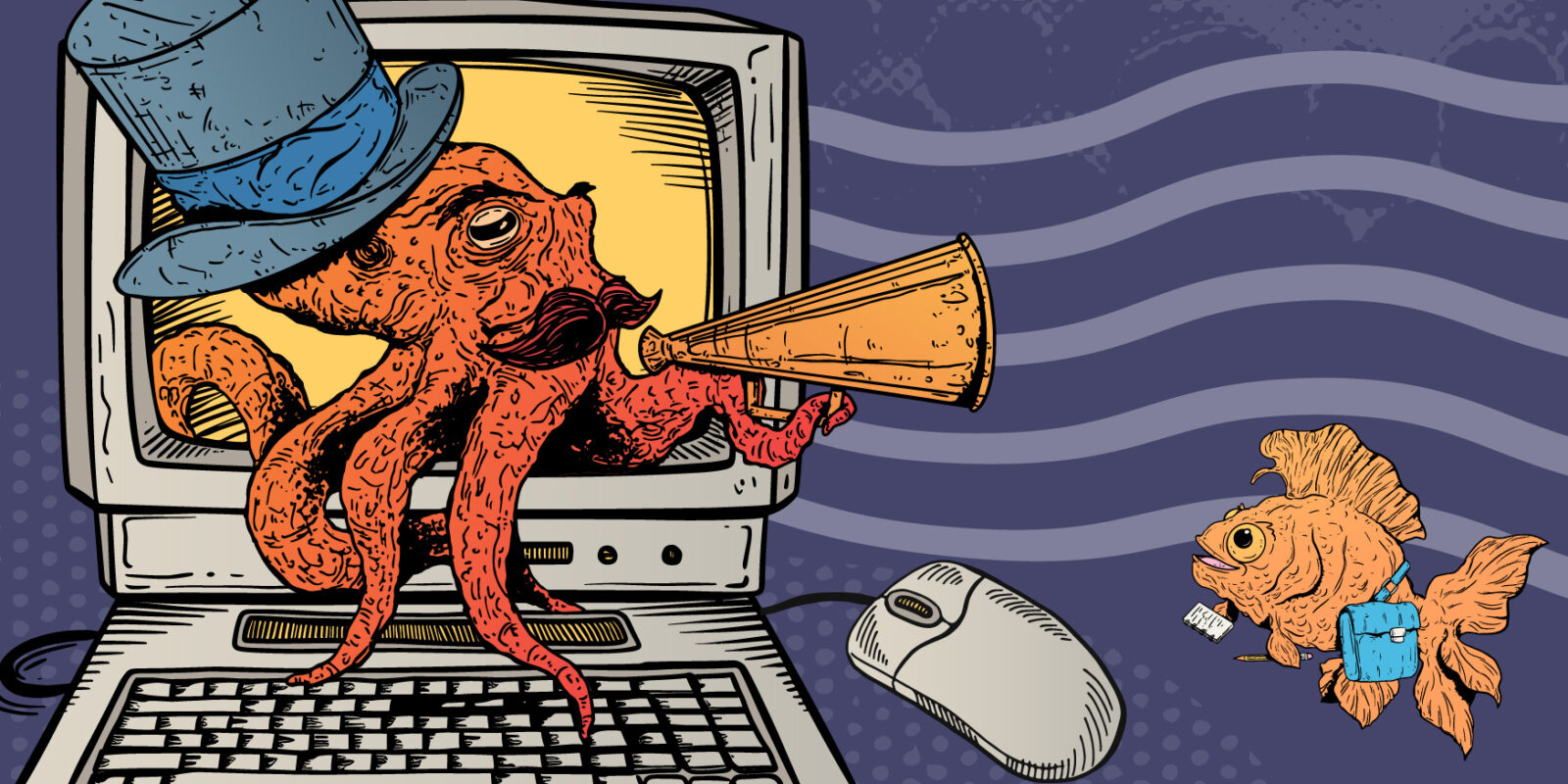

AI can write fast. Like, suspiciously fast.
You paste in a prompt. It spits out a LinkedIn post, three emails, and a headline before your coffee cools down. Efficient? Yes. Impressive? Sure.
Trust-building? Not automatically.
If you’ve ever read something your team generated and thought, “This sounds…fine but also weirdly hollow,” you’re not alone. April is our unofficial “voice season” at Kraken Sales Funnels, and we’re calling it like it is: AI can help you move faster, but your brand still has to sound like a real human that people trust.
Let’s run your content through a quick bot-detector and then fix it with a repeatable, practical system you can use every week.
Why “Sounds Like a Bot” Breaks Trust Fast
You don’t need software to detect robotic copy. Humans can feel it.
When marketing tone of voice shifts from distinctive to generic, people subconsciously assume:
- No one really thought this through
- This was churned out
- This could belong to anyone
And if it could belong to anyone, it doesn’t belong to you.
Trust doesn’t usually collapse dramatically. It erodes quietly, and generic AI marketing copy accelerates that erosion.
The #1 Reason AI Output Feels Fake
It comes down to one thing: specifics.
AI-generated content often feels artificial because it’s missing details that anchor it in reality. No names, no numbers, and no actual stakes. Just broad claims and polished filler.
It’s not that the copy is wrong; it’s that it’s untethered. And untethered content feels like a catfish.
The “Catfish Test”
If your marketing copy looks polished but doesn’t resemble how you actually talk, it’s catfishing your audience.
It may technically represent your company, but it doesn’t sound like you. And customers can sense that mismatch immediately.
Pass the Catfish Test, and your content feels aligned. Fail it, and even great design won’t save it.
The Most Common Bot Tells (and Why They Hurt)
Let’s have a little fun and call out the biggest offenders. No shame. We’ve all shipped at least one of these.
Bot Tell #1: Vague Excitement
“We’re excited to announce…”
Excited about what? Why? What changes for me? Excitement without context feels performative, like emotional filler.
Bot Tell #2: Corporate Filler Phrases
These phrases are technically correct…
- “Cutting-edge solutions.”
- “Comprehensive services.”
- “Leveraging innovation.”
… and strategically empty.
Bot Tell #3: Universal Claims With No Proof
“This will transform your business.”
How? For whom? Based on what? AI loves universal claims, but humans trust specifics.
Bot Tell #4: Perfect Grammar + Zero Personality
AI loves evenly structured sentences of similar length because they read smoothly… while also saying nothing memorable.
Human writing has rhythm, variation, and a little edge.
Bot Tell #5: Generic Empathy Lines
“We understand how challenging this can be.”
Do you? In what context? For whom? Empathy without detail feels like a customer service script from 2006.
What “Human Voice” Actually Means in Marketing
Human voice in marketing isn’t slang. It’s not emojis or trying to sound casual.
Human voice is:
- Specific
- Opinionated (within reason)
- Grounded in reality
- Rhythmically varied
- Slightly imperfect in a good way
When you’re humanizing AI content, you’re not trying to make it messy. You’re trying to make it believable.
The Kraken Rewrite Method
Here’s the repeatable system we recommend to make AI marketing copy sound human:
1. Build a 1-Page Brand Voice Card
Before you edit anything, define what you should sound like.
Your brand voice guide should include:
- Three adjectives you want to embody
- Two tones you refuse to use
- One belief you repeat consistently
- One thing competitors say that you avoid
Keep it to one page. If it’s longer, no one will use it.
2. Create a “Do Not Use” List
AI defaults to safe language. You need guardrails.
Examples:
- “We’re excited to…”
- “In today’s fast-paced world…”
- “Best-in-class”
- “Seamless experience”
Your list becomes part of your AI copy editing checklist.
3. Add Signature Moves
Signature moves make your brand recognizable.
Maybe you:
- Use punchy one-liners
- Ask sharp rhetorical questions
- Include mini case snippets
- Contrast “what most people do” vs “what actually works”
AI won’t invent these for you. You have to define them.
4. Enforce the Specificity Requirement
No post goes live without at least one of these:
- A name
- A number
- A timeline
- A measurable outcome
- A clear example
Humanizing AI content starts with anchoring it in reality.
5. Apply the Rhythm Rule
If every sentence is the same length, your copy will feel mechanical. Mix it up with:
- Short sentences.
- Longer explanations
- A quick punchline
Rhythm makes writing feel alive.
6. The “One Opinion” Rule
Even in cautious industries, you can take one brand-aligned stance.
Instead of: “AI can be helpful in many situations.”
Try: “AI is a drafting tool. It’s not your marketing strategist.”
That single opinion makes the copy feel intentional.
7. The Proof Snippet Rule
You don’t need case studies in every post. But you do need micro-proof.
- “We’ve seen this triple reply rates.”
- “Three of our clients made this mistake last quarter.”
- “In one audit, 70% of posts were AI-first-draft content.”
Tiny evidence beats big promises.
Before & After: LinkedIn Example
Before (AI Draft)
“AI is transforming marketing by enabling businesses to scale content production and improve efficiency. By leveraging AI tools, companies can enhance productivity and drive results.”
Technically, this is fine. Emotionally, it’s vacant.
After (Humanized)
“AI will absolutely help you move faster. It just won’t make you more interesting.
We audited 200 recent LinkedIn posts last month. The ones that flopped had one thing in common: zero specifics.
Speed is great. Substance wins.”
Same topic. Different energy.
Before & After: Email Intro Example
Before (AI Draft)
“We understand that managing marketing campaigns can be challenging. Our team is here to support your business with innovative solutions.”
Safe, predictable, and forgettable.
After (Humanized)
“If your marketing feels busy but not productive, you’re not alone.
Most teams don’t have a strategy problem. They have a clarity problem.
Let’s fix that.”
Still professional. But now it feels like someone wrote it.
Workflow: Draft with AI, Finish with a Human
Responsible AI in marketing isn’t about avoiding the tools. It’s about using them efficiently.
Here’s a clean workflow:
- Draft with AI
- Apply your brand voice card
- Run the AI content checklist
- Add specificity + rhythm
- Insert one opinion
- Add one proof snippet
- Final human review
AI writes the clay, but humans sculpt it.
Responsible AI Includes What You Publish
Here’s something we don’t talk about enough:
- Every unnecessary iteration
- Every generic post that doesn’t land
- Every rewrite because the first draft was lazy
That’s all digital clutter. Responsible AI isn’t just about compliance or ethics. It’s about efficiency. Cleaner prompts with fewer revisions, paired with stronger data, lead to less content waste and better marketing.
AI Is Powerful. Your Process Makes It Profitable.
AI marketing copy doesn’t fail because it’s artificial; it fails because it’s unfinished.
If you want to move faster and protect your brand voice, you need structure. A system that ensures your content sounds like you — even when AI is involved.
That’s exactly what we build at Kraken Sales Funnels. Our system helps you:
- Define your voice
- Create AI copy editing rules
- Build repeatable workflows
- Integrate responsible AI into your marketing operations
Because speed is great, but trust scales better. Book a consult with Kraken now and let us help you use AI responsibly and efficiently.
